If you’ve spent any time texting, scrolling through social media, or chatting in online communities, you’ve probably seen the abbreviation TYSM appear in conversations. It often pops up after someone receives help, support, advice, or even a simple compliment.
Many people understand that it relates to gratitude, yet they are not always sure what it stands for or how it differs from other expressions like “thanks” or “thank you.” Some wonder whether it sounds sincere. Others question if it is appropriate in every situation.
The popularity of texting shortcuts has transformed the way people communicate. Abbreviations allow users to express feelings quickly while keeping conversations casual and natural. TYSM is one of the most common examples.
Understanding what TYSM means can help you interpret messages more accurately and use the expression confidently in your own conversations. It also reveals how modern digital communication blends efficiency with emotion.
What Is TYSM in Texting? – Quick Meaning
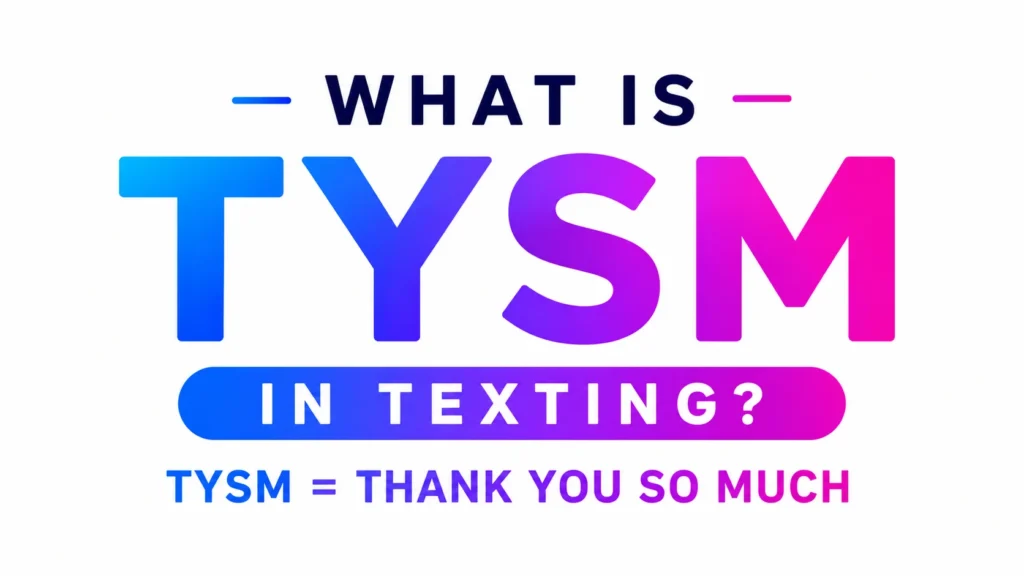
TYSM stands for “Thank You So Much.”
It is a warm and enthusiastic way of expressing appreciation through text messages, social media posts, comments, and online chats.
People use TYSM when a simple “thanks” does not feel strong enough.
Quick Definition
- TYSM = Thank You So Much
- Expresses gratitude and appreciation
- Common in texting and social media
- Usually friendly and positive
- Often used among friends, family members, and online communities
Examples
“TYSM for helping me study.”
“TYSM! That advice really worked.”
“You remembered my birthday. TYSM!”
The abbreviation may be short, though the emotion behind it is often genuine.
Origin & Background
TYSM emerged from the broader culture of internet abbreviations and mobile texting.
During the early years of text messaging, character limits encouraged users to shorten frequently used phrases. Expressions such as LOL, BRB, OMG, and TY quickly became common.
As digital communication evolved, users searched for ways to express stronger emotions without typing long messages. TYSM became a natural solution because it conveyed greater appreciation while remaining concise.
The phrase gained popularity across:
- Text messaging
- Instant messaging apps
- Online gaming communities
- Social media platforms
- Fan communities
- Student group chats
Social media played a significant role in expanding its use. Platforms encouraged quick interactions, making abbreviations practical and recognizable.
Over time, TYSM became more than a shortcut. It evolved into a friendly expression associated with warmth, kindness, and enthusiasm.
Real-Life Conversations
WhatsApp Conversation
Andrew:
I emailed you the project notes.
David:
Seriously?
Andrew:
Yep. Check your inbox.
David:
TYSM. You just saved me hours.
Instagram DM
Sophia:
I found the shoes you were looking for.
Emma:
No way.
Sophia:
I sent you the link.
Emma:
TYSM! I’ve been searching for weeks.
TikTok Comments
Liam:
What’s the song in this video?
Chloe:
It’s listed in the caption.
Liam:
I completely missed it.
Chloe:
No worries.
Liam:
TYSM!
Text Message
Ryan:
I picked up your package.
Mia:
Really?
Ryan:
Yep.
Mia:
TYSM. That helps a lot.
These conversations demonstrate how naturally TYSM fits into everyday communication.
Emotional & Psychological Meaning
At its core, TYSM expresses gratitude.
The phrase often communicates more than appreciation alone.
Human relationships thrive on acknowledgment. People like to feel valued and appreciated. TYSM serves as a quick yet meaningful way to recognize another person’s effort.
A memorable example comes from helping a friend prepare for an important interview. After reviewing practice questions together, I received a simple message later that evening: “TYSM. I feel much more confident now.”
The message contained only four letters, yet the appreciation felt completely genuine. That experience highlights why the expression remains popular.
Usage in Different Contexts
Social Media
TYSM appears frequently in comments, direct messages, replies, and captions.
People use it to thank followers, friends, creators, and community members.
Friends and Relationships
Among friends, the phrase feels natural and warm.
In relationships, it can communicate affection, appreciation, and emotional closeness.
Work and Professional Settings
Professional environments typically favor complete phrases such as “thank you” or “thank you very much.”
TYSM may appear in informal workplace chats, though it is less suitable for formal communication.
Casual vs Serious Tone
Casually, TYSM sounds friendly and energetic.
In more serious situations, writing out the full phrase may feel more personal and respectful.
Context influences how the message is received.
When NOT to Use It
TYSM is widely accepted, though some situations call for more formal language.
Avoid using it:
- In professional emails
- During official business communication
- In academic papers
- When addressing senior executives
- During highly formal events
The abbreviation may appear too casual in these circumstances.
Cultural expectations can also influence how abbreviations are perceived.
Some individuals prefer complete expressions of gratitude, especially during important interactions.
Common Misunderstandings
Assuming It Is Insincere
Some people believe abbreviations reduce emotional sincerity.
In reality, many users genuinely mean every word behind TYSM.
Thinking It Is Only for Teenagers
While younger generations use it frequently, adults also use the expression in casual digital conversations.
Confusing It With Simple Thanks
TYSM carries more enthusiasm than a basic “thanks.”
The added words emphasize stronger appreciation.
Believing It Is Always Informal
The abbreviation itself is informal.
The emotion behind it can still be sincere and meaningful.
Literal vs Figurative Meaning
Literally, it means “Thank You So Much.”
Figuratively, it often communicates warmth, gratitude, relief, or appreciation.
Comparison Table
| Expression | Meaning | Relationship to TYSM |
|---|---|---|
| TYSM | Thank You So Much | Standard expression |
| TY | Thank You | Shorter version |
| Thanks | Basic appreciation | Less enthusiastic |
| Thank You | Full phrase | More formal |
| Tysm!!! | Strong excitement | Emphasized gratitude |
| Much Appreciated | Professional gratitude | Formal alternative |
| No Thanks | Polite refusal | Opposite purpose |
| Grateful | Deep appreciation | Related expression |
Key Insight
TYSM remains popular because it balances convenience and emotion. It allows people to express genuine gratitude quickly while maintaining a friendly tone.
Variations / Types
1. TY
A shorter version meaning “Thank You.”
2. TYSM
The standard abbreviation for “Thank You So Much.”
3. Tysm
A lowercase variation commonly used in texting.
4. TYVM
Means “Thank You Very Much.”
5. TYSM!!!
Adds excitement and enthusiasm.
6. Thanks
The traditional informal version.
7. Thank You
The complete phrase.
8. Much Appreciated
A respectful alternative.
9. Appreciate It
A conversational way to show gratitude.
10. Big Thanks
Expresses stronger appreciation.
How to Respond When Someone Uses It
Casual Replies
- “You’re welcome.”
- “No problem.”
- “Glad I could help.”
Funny Replies
- “My gratitude collection grows.”
- “I’ll accept this appreciation.”
- “Mission accomplished.”
Mature Replies
- “Happy to help.”
- “I’m glad it worked out.”
- “Anytime you need assistance.”
Respectful Replies
- “You’re very welcome.”
- “It was my pleasure.”
- “I’m glad I could support you.”
Regional & Cultural Usage
Western Culture
TYSM is widely recognized in texting and social media.
Many users view it as friendly and sincere.
Asian Culture
The abbreviation is common among younger internet users familiar with English-language digital communication.
Some cultures still favor more formal expressions in professional settings.
Middle Eastern Culture
English-speaking online communities frequently use TYSM.
Respectful communication remains important, particularly in formal interactions.
Global Internet Usage
The phrase has spread internationally through social media, gaming, and messaging apps.
Millions of users recognize its meaning regardless of location.
Gen Z vs Millennials
Gen Z often uses abbreviations naturally during daily conversations.
Millennials generally understand TYSM and use it regularly, though some prefer complete phrases in certain situations.
Is It Safe for Kids?
Yes, TYSM is considered safe for children.
The expression simply communicates gratitude and appreciation.
Parents can view it as a positive example of polite digital communication. Teaching children the value of genuine gratitude remains important whether they use abbreviations or full phrases.
FAQs
What does TYSM mean in texting?
TYSM means “Thank You So Much.”
Is TYSM polite?
Yes. It is a friendly and positive way to express gratitude.
Can adults use TYSM?
Absolutely. The phrase is common among users of various age groups.
Is TYSM professional?
Not usually. Full phrases are generally better for formal communication.
What is the difference between TY and TYSM?
TY means “Thank You,” while TYSM expresses stronger appreciation.
Is TYSM popular on social media?
Yes. It appears frequently in comments, captions, and direct messages.
Can TYSM sound sincere?
Yes. The abbreviation often conveys genuine gratitude despite its short form.
Conclusion
TYSM stands for “Thank You So Much,” a simple abbreviation that carries a surprisingly meaningful message. In a digital world where conversations happen quickly, it provides an easy way to express appreciation without sacrificing warmth.
The phrase appears across texting apps, social media platforms, online communities, and everyday conversations. Its popularity comes from its ability to combine efficiency with genuine emotion.
Understanding what TYSM means helps you recognize the gratitude behind the message and respond appropriately. Whether you use it yourself or receive it from someone else, the expression represents one of the most positive aspects of modern communication: taking a moment to acknowledge and appreciate another person.
A few letters can make someone feel valued. That simple truth explains why TYSM continues to thrive in online conversations around the world.