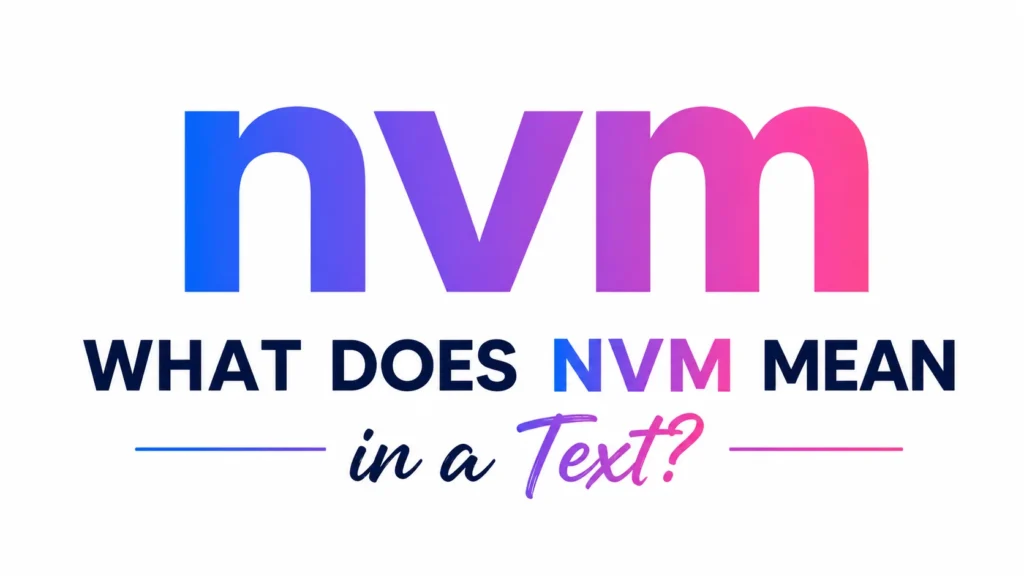
If you spend any time texting, scrolling through social media, or chatting online, you’ve probably come across the abbreviation NVM. It appears in text messages, Instagram conversations, gaming chats, and even workplace messaging apps. Yet many people still wonder: what does NVM mean in a text?
The confusion usually comes from the fact that NVM can carry different emotions depending on the situation. Sometimes it sounds casual and harmless. Other times it may seem disappointed, frustrated, or even slightly passive-aggressive.
Understanding the meaning behind NVM helps you avoid misunderstandings and communicate more effectively in digital conversations. This guide explains exactly what it means, where it came from, how people use it, and how you should respond when someone sends it.
NVM – Quick Meaning
NVM stands for “Never Mind.”
People use it when they want to:
- Cancel a question
- Drop a topic
- Indicate they figured something out themselves
- Show that an answer is no longer needed
- End a conversation about a particular subject
Examples
“NVM, I found the information.”
“NVM, it’s not important anymore.”
“NVM lol, I figured it out.”
In most situations, NVM simply means “don’t worry about it” or “forget what I said.”
Origin & Background
NVM is a shortened version of the phrase “never mind.”
The expression itself has existed in English for centuries and traditionally meant “pay no attention to that” or “forget what was just said.”
As texting became popular in the late 1990s and early 2000s, people started shortening common phrases to save time and characters. Similar abbreviations emerged, including:
- BRB (Be Right Back)
- IMO (In My Opinion)
- IDK (I Don’t Know)
- TTYL (Talk To You Later)
NVM quickly became a favorite because it was short, easy to type, and useful in everyday conversations.
The rise of smartphones, social media, and instant messaging made NVM even more common. Today, it is recognized across platforms including WhatsApp, Instagram, TikTok, Snapchat, Discord, and Messenger.
Its meaning has stayed mostly the same over time, although the emotional tone can vary depending on context.
Real-Life Conversations
WhatsApp Conversation
Andrew:
Hey, do you know where the meeting notes are?
David:
Not sure. Let me check.
Andrew:
NVM, I found them in my email.
David:
Great, glad you found them.
Instagram DM
Sophia:
Did you delete your latest post?
Emma:
Which one?
Sophia:
NVM, Instagram wasn’t loading properly.
Emma:
That makes sense. It’s working now.
TikTok Comments
Jake:
What song is playing in this video?
Liam:
I think it’s from a new artist.
Jake:
NVM, I checked the caption and found it.
Liam:
Nice catch.
Text Message
Mia:
Can you send me the address again?
Olivia:
Sure.
Mia:
NVM, I found the old message.
Olivia:
Perfect. See you soon.
Emotional & Psychological Meaning
Although NVM literally means “never mind,” the emotional message behind it can change.
Sometimes it expresses independence. A person asks a question, finds the answer, and no longer needs help.
Other times it can reveal disappointment. Someone may feel ignored if they don’t receive a response quickly.
In certain conversations, NVM acts as a protective phrase. Rather than repeating a request or explaining their feelings, people choose to move on.
Imagine texting a friend:
“Can we talk?”
Hours pass without a reply.
Eventually you send:
“NVM.”
The word may technically mean “forget it,” but it can also communicate frustration, sadness, or resignation.
This emotional flexibility is one reason context matters so much when interpreting NVM.
Usage in Different Contexts
Social Media
On social media, NVM often signals that someone found the answer independently.
Example:
“NVM, I found the link in your bio.”
The tone is usually neutral.
Friends and Relationships
Among friends, NVM is common and informal.
Example:
“NVM, I remembered what you told me.”
In close relationships, the tone may sometimes hint at disappointment if a response takes too long.
Work and Professional Settings
NVM can appear in workplace chats, though many professionals prefer writing the full phrase “never mind.”
Example:
“Never mind, the issue has been resolved.”
The complete phrase sounds more polished.
Casual vs Serious Tone
In casual conversations, NVM feels natural.
In serious discussions involving emotions, conflicts, or important decisions, using NVM may seem dismissive or abrupt.
The surrounding conversation determines how it is interpreted.
When NOT to Use It
There are situations where NVM may create confusion or appear insensitive.
Professional Emails
Formal communication benefits from complete sentences.
Instead of:
“NVM.”
Try:
“Thank you, I resolved the issue.”
Serious Discussions
Avoid using NVM when discussing sensitive topics.
The phrase may appear dismissive and shut down meaningful conversation.
Customer Service Situations
Clear communication is better than abbreviations.
Not everyone understands internet slang.
Cross-Cultural Conversations
Some people may not recognize NVM and could misunderstand your intention.
When clarity matters, write out “never mind.”
Common Misunderstandings
Assuming It Is Always Rude
Many people think NVM sounds annoyed.
In reality, it is often completely neutral.
Confusing Tone
Text messages lack facial expressions and voice cues.
The same NVM can sound friendly, disappointed, impatient, or humorous depending on context.
Taking It Literally
People sometimes interpret NVM as a rejection of help.
Frequently, the sender simply solved the problem independently.
Reading Hidden Meaning
Not every NVM carries emotional weight.
Sometimes it is just a quick update.
Comparison Table
| Expression | Meaning | Tone | Usage |
|---|---|---|---|
| NVM | Never mind | Neutral to emotional | Drop the topic |
| IDC | I don’t care | Indifferent | Express lack of concern |
| IDK | I don’t know | Neutral | Admit uncertainty |
| JK | Just kidding | Playful | Clarify a joke |
| Forget it | Stop discussing it | Stronger | Can sound frustrated |
| No worries | Everything is okay | Positive | Reassurance |
| Carry on | Continue | Encouraging | Keep moving forward |
| FYI | For your information | Informative | Share information |
Key Insight
NVM is generally softer than “forget it” but more final than “no worries.” Its exact meaning depends heavily on the emotional context surrounding the conversation.
Variations / Types
1. Nvm
The standard lowercase version commonly used in texts.
2. NVM
The uppercase version used for emphasis.
3. Nvmd
A slightly extended spelling of never mind.
4. Nvm lol
Adds humor and lightheartedness.
5. Nvm, I got it
Shows the problem has been solved.
6. Nvm then
May suggest mild disappointment.
7. Nvm thanks
Politely withdraws a request.
8. Nvm haha
Keeps the tone friendly and relaxed.
9. Nvm, all good
Indicates everything is resolved.
10. Never mind
The full written version, often preferred in professional settings.
How to Respond When Someone Uses It
Casual Replies
- “Got it.”
- “Okay!”
- “No problem.”
- “Sounds good.”
Funny Replies
- “Mystery solved.”
- “Case closed.”
- “The detective strikes again.”
- “You beat me to it.”
Mature Replies
- “Glad you found the answer.”
- “Happy it worked out.”
- “Let me know if you need anything else.”
Respectful Replies
- “Understood.”
- “Thank you for the update.”
- “Feel free to reach out anytime.”
Regional & Cultural Usage
Western Culture
NVM is widely understood in North America, the United Kingdom, Australia, and many other English-speaking regions.
People use it casually among friends, family members, and online communities.
Asian Culture
Many English-speaking internet users across Asia recognize NVM because of social media, gaming platforms, and messaging apps.
The abbreviation is especially common among younger generations.
Middle Eastern Culture
NVM appears frequently in bilingual online communication where English is used alongside local languages.
Many users learn the term through global social networks.
Global Internet Usage
Online culture has made NVM nearly universal.
Gamers, creators, influencers, students, and professionals regularly encounter it.
Generational Differences
Gen Z tends to use NVM naturally and frequently.
Millennials also understand it well because they grew up during the rise of texting culture.
Older generations may recognize the phrase “never mind” but not always the abbreviation itself.
Is It Safe for Kids?
Yes.
NVM is generally considered safe for children and teenagers. It is a harmless abbreviation for “never mind” and does not contain offensive or inappropriate content.
Parents should still encourage children to pay attention to context, since the tone behind the phrase can sometimes communicate frustration or disappointment.
FAQs
What does NVM mean in texting?
NVM stands for “never mind.” It means the sender no longer needs an answer or wants to move on from the topic.
Is NVM rude?
Not usually. Most of the time it is neutral, though context can make it sound frustrated or dismissive.
What should I reply to NVM?
Simple responses such as “okay,” “got it,” or “glad you found it” usually work well.
Is NVM the same as “forget it”?
They are similar, but “forget it” can sound stronger and more emotional.
Do adults use NVM?
Yes. People of all ages use it, especially in digital communication.
Can NVM be used at work?
It can, but writing “never mind” is often more professional.
Why do people say NVM after asking a question?
Usually because they found the answer themselves or no longer need help.
Conclusion
Understanding what does NVM mean in a text can make online conversations much easier to interpret. At its core, NVM simply means “never mind.” It tells the other person that an answer is no longer needed, a problem has been solved, or a topic can be dropped.
The phrase may seem simple, yet its emotional tone can shift depending on timing, context, and relationships. Sometimes it communicates efficiency. Other times it reveals impatience, disappointment, or a desire to move on.
The key is to look beyond the letters and consider the conversation as a whole. Once you understand that context, using and responding to NVM becomes natural and confident.