If you have seen “SG” in a text message, social media comment, gaming chat, or online conversation, you may have wondered what it actually means. The confusion is understandable because SG can represent different things depending on the situation, platform, and audience.
People often search for the meaning of SG because they encounter it in casual conversations and want to avoid misunderstanding the message. In some cases, it is used as a quick abbreviation. In others, it may refer to a location, group, gaming term, or personal expression.
Understanding SG helps you communicate more confidently online and offline. Once you know the context behind it, the abbreviation becomes much easier to interpret.
SG – Quick Meaning
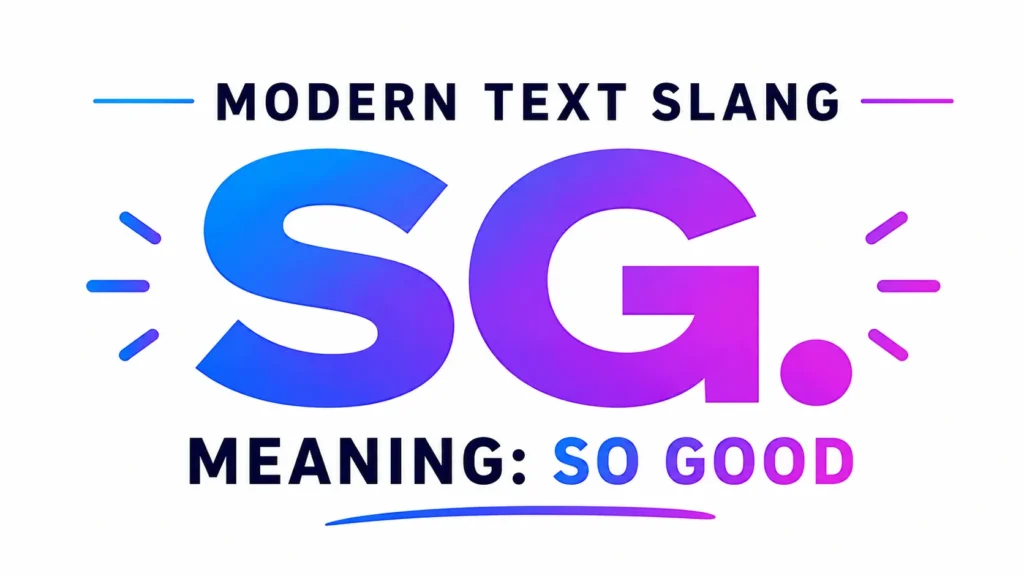
The most common meaning of SG is:
- Sounds Good
- A quick way of expressing agreement or approval
- Often used in texting, chats, and social media conversations
Examples:
“Meet at 7 PM?”
“SG.”
“I’ll send the details later.”
“SG, thanks.”
“Let’s talk tomorrow.”
“SG!”
Depending on context, SG can also refer to:
- Singapore
- Study Group
- Gaming clans or teams
- Specific community abbreviations
The surrounding conversation usually reveals the intended meaning.
Origin & Background
The abbreviation SG emerged from the growing need for faster digital communication. As texting became more common, people began shortening frequently used phrases.
“Sounds Good” naturally became SG because it is short, easy to type, and instantly recognizable among regular internet users.
During the rise of instant messaging platforms, abbreviations such as LOL, BRB, IMO, and SG became part of everyday communication. Young users adopted them first, but many adults now use them as well.
Social media accelerated the spread of SG. Platforms that encourage quick replies made short expressions more valuable. Instead of typing a complete sentence, users could respond with two simple letters.
Over time, SG evolved beyond texting. It now appears in:
- WhatsApp chats
- Instagram conversations
- TikTok comment sections
- Gaming communities
- Workplace messaging platforms
The meaning often remains the same: agreement, approval, or acknowledgment.
Real-Life Conversations
WhatsApp Conversation
Andrew:
Are we still meeting for coffee after work?
David:
Yes, around 6 PM.
Andrew:
Perfect. I’ll reserve a table.
David:
SG. See you then.
Instagram DM
Sophia:
You should post that travel photo.
Emma:
Really? I wasn’t sure.
Sophia:
Absolutely. It looks amazing.
Emma:
SG, I’ll upload it tonight.
TikTok Comments
Mason:
Part 2 please!
Olivia:
Working on it now.
Mason:
SG. Can’t wait to watch.
Text Message
Ryan:
Let’s postpone the meeting until Friday.
Noah:
That works for me.
Ryan:
Great.
Noah:
SG.
These examples show how SG functions as a quick confirmation without requiring a lengthy response.
Emotional & Psychological Meaning
At first glance, SG looks simple. Beneath the surface, it serves an important emotional purpose.
When someone says SG, they are often communicating:
- Agreement
- Trust
- Cooperation
- Openness
- Convenience
The abbreviation reduces friction in communication. Instead of writing a detailed response, a person can instantly signal that everything is fine.
Psychologically, SG creates conversational momentum. It helps discussions move forward without unnecessary delays.
Imagine a friend suggesting a weekend plan after several busy weeks. Rather than composing a long reply, you simply respond with “SG.” That short message communicates acceptance and enthusiasm without adding complexity.
In modern communication, people value speed and clarity. SG fulfills both needs while maintaining a friendly tone.
Usage in Different Contexts
Social Media
On social platforms, SG often means “Sounds Good.”
Examples:
- Approving collaboration ideas
- Agreeing with content plans
- Responding to invitations
- Confirming future conversations
Its short format matches the fast pace of social media interactions.
Friends & Relationships
Among friends, SG feels casual and comfortable.
Examples:
- Planning dinner
- Organizing trips
- Choosing activities
- Confirming schedules
The abbreviation signals friendliness without appearing overly formal.
Work and Professional Settings
SG occasionally appears in workplace chats.
Example:
“Let’s move the presentation to Thursday.”
“SG. I’ll update the calendar.”
Many professionals use it internally, especially in messaging apps. Formal emails usually require complete wording instead.
Casual vs Serious Tone
Casual:
“Movie at 8?”
“SG.”
More Serious:
“Please review the legal agreement before signing.”
Using only “SG” may seem too brief in this situation.
The seriousness of the topic should guide your response style.
When NOT to Use It
Although SG is widely accepted, there are situations where it may not be appropriate.
Formal Business Communication
Avoid using SG in:
- Legal documents
- Official reports
- Academic submissions
- Formal client correspondence
A complete response appears more professional.
Sensitive Conversations
Topics involving:
- Grief
- Health concerns
- Family emergencies
- Serious conflicts
often require greater emotional expression.
A simple SG may feel dismissive.
Cross-Cultural Communication
Not everyone understands internet abbreviations.
Using SG with unfamiliar audiences may create confusion.
Important Instructions
When precise understanding matters, writing a full sentence is usually safer than relying on shorthand.
Common Misunderstandings
Several misconceptions surround SG.
Assuming Only One Meaning
Many people believe SG always means “Sounds Good.”
In reality, context determines the meaning.
Geographic Confusion
Some users interpret SG as Singapore, particularly in international conversations.
Example:
“I moved to SG last year.”
Here, SG likely refers to Singapore.
Tone Misinterpretation
Because SG is brief, some readers may view it as:
- Disinterested
- Rushed
- Emotionally distant
The sender may simply be trying to communicate efficiently.
Literal vs Figurative Meaning
SG is rarely meant literally. It functions more as a conversational signal than a detailed statement.
Comparison Table
| Expression | Meaning | Tone | Usage |
|---|---|---|---|
| SG | Sounds Good | Friendly | Agreement |
| OK | Acceptable | Neutral | Confirmation |
| Sure | Willing agreement | Casual | Everyday conversations |
| Yep | Yes | Informal | Friendly chats |
| Absolutely | Strong agreement | Enthusiastic | Positive responses |
| Fine | Acceptance | Neutral or reluctant | Mixed contexts |
| No Way | Opposite meaning | Negative | Rejection |
| I Agree | Direct agreement | Professional | Formal situations |
Key Insight
SG stands out because it balances speed and friendliness. It communicates approval without sounding overly enthusiastic or overly formal.
Variations / Types
1. SG
Standard form meaning “Sounds Good.”
2. SGTM
Sounds Good To Me.
3. SGG
Sounds Good, Go ahead.
4. SG 👍
Agreement reinforced with a thumbs-up emoji.
5. SG Thanks
Approval combined with appreciation.
6. SG Perfect
Agreement plus enthusiasm.
7. SG See You Then
Confirmation of future plans.
8. SG Let’s Do It
Agreement followed by action.
9. SG Works for Me
Acceptance of a suggestion.
10. SG Definitely
Stronger and more enthusiastic approval.
How to Respond When Someone Uses It
Casual Replies
- Great!
- Awesome.
- Perfect.
- Sounds like a plan.
Funny Replies
- Glad we’re on the same page.
- Excellent, crisis avoided.
- Agreement unlocked.
- Teamwork achieved.
Mature Replies
- Thank you for confirming.
- I appreciate the quick response.
- I’ll proceed accordingly.
- Glad we reached an agreement.
Respectful Replies
- Thank you.
- Much appreciated.
- Looking forward to it.
- Have a great day.
Regional & Cultural Usage
Western Culture
In North America and many European countries, SG is commonly interpreted as “Sounds Good.”
It fits naturally into fast-paced digital communication.
Asian Culture
Usage varies significantly across countries.
In some contexts, SG may immediately be associated with Singapore rather than agreement.
The surrounding message becomes especially important.
Middle Eastern Culture
Many users understand SG through global internet culture. However, full phrases are still preferred in more formal settings.
Global Internet Usage
Online communities have created shared communication habits. SG has become recognizable across borders because of gaming, social media, and messaging apps.
Gen Z vs Millennials
Gen Z
- Uses abbreviations frequently
- Prefers speed and efficiency
- Comfortable with internet shorthand
Millennials
- Generally understand SG
- May alternate between abbreviations and full phrases
- Often adjust communication based on audience
Both generations use SG, though frequency may differ.
Is It Safe for Kids?
Yes, SG is generally considered safe for children.
The abbreviation is commonly used to mean “Sounds Good” and does not contain offensive or harmful language.
Parents should still encourage children to understand context because abbreviations can have different meanings in different online communities.
FAQs
What does SG mean in texting?
Most commonly, it means “Sounds Good,” expressing agreement or approval.
Does SG always mean Sounds Good?
No. In some contexts, it may refer to Singapore, Study Group, or other community-specific meanings.
Is SG rude?
Not usually. It is generally viewed as friendly and efficient.
Can SG be used at work?
Yes, in informal workplace chats. Formal communication often requires complete wording.
What is the difference between SG and OK?
SG usually sounds warmer and more positive than a simple OK.
Is SG popular on social media?
Yes. It appears frequently in messaging apps, comments, and direct messages.
Should I use SG with people I don’t know?
Use caution. Some people may not recognize the abbreviation, so a full phrase may be clearer.
Conclusion
SG is a simple abbreviation with a surprisingly useful role in modern communication. Most often meaning “Sounds Good,” it helps people express agreement quickly while keeping conversations friendly and efficient.
Its popularity comes from the way people communicate today—fast, direct, and increasingly digital. Understanding the context behind SG prevents misunderstandings and allows you to respond naturally in conversations across social media, messaging apps, and everyday interactions.
Whether you encounter it in a WhatsApp chat, Instagram DM, TikTok comment, or workplace message, you can now recognize its meaning with confidence and use it appropriately when the situation calls for it.