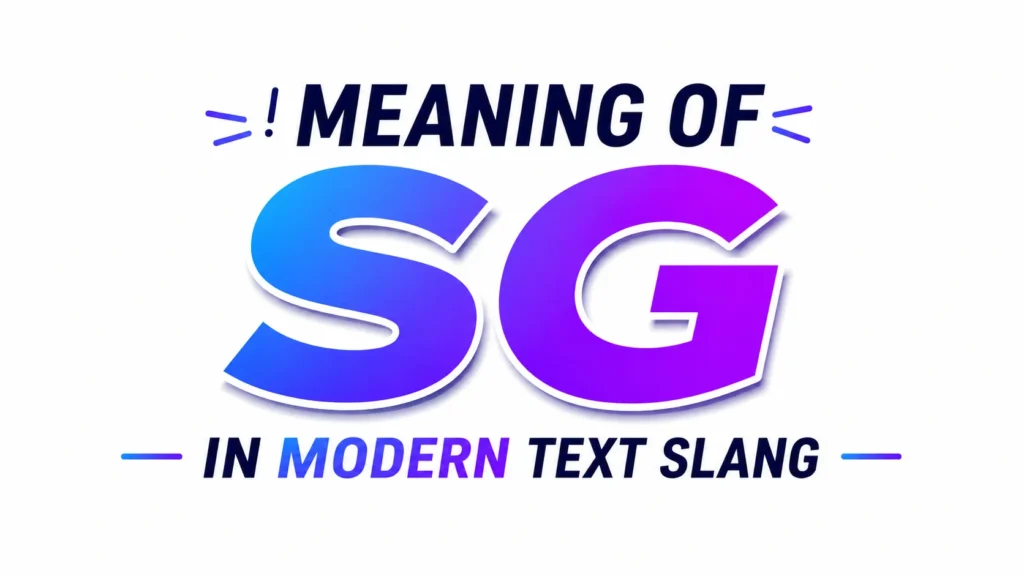
If you spend time on social media, gaming platforms, text messages, or online communities, you may have seen the abbreviation SG and wondered what it means. The answer is not always straightforward because SG can have several meanings depending on the conversation.
Many people search for the meaning of SG after spotting it in a chat, comment section, gaming discussion, or social media post. Without context, it can be confusing because the same two letters are used in different ways across different communities.
In casual online communication, SG often stands for “Sounds Good.” In other situations, it may refer to a location, gaming term, organization, or nickname. Understanding the context helps you interpret the message correctly and respond with confidence.
This guide breaks down the meaning of SG, its origins, common uses, emotional significance, and how people use it across modern digital communication.
SG – Quick Meaning
The most common meaning of SG in texting and online conversations is:
- SG = Sounds Good
People use it as a quick response to show agreement or approval.
Examples
“Let’s meet at 7 PM.”
“SG.”
“I’ll send the details tomorrow.”
“SG, thanks.”
“We’ll talk after work.”
“SG.”
In these examples, SG simply means the person agrees with the plan.
Origin & Background
The rise of SG reflects the broader evolution of internet communication. As texting became more common, users looked for faster ways to express common phrases.
Instead of typing “sounds good” repeatedly, many people shortened it to SG. This saved time while keeping conversations moving smoothly.
The abbreviation gained popularity through:
- SMS texting
- Online gaming chats
- Internet forums
- Social media messaging
- Group conversations
Gaming communities played a major role in spreading SG. Players often needed quick responses while focusing on gameplay. Short abbreviations became practical tools for communication.
Social media later introduced SG to a wider audience. Messaging apps encouraged brief replies, making abbreviations feel natural.
Although SG still commonly means “sounds good,” different communities sometimes assign alternative meanings. Context remains the key to understanding it correctly.
Real-Life Conversations
WhatsApp Conversation
Andrew:
Can we move our meeting to 5 PM?
David:
SG. That works better for me.
Andrew:
Perfect. I’ll send the updated invite.
Instagram DM Conversation
Sophia:
Want to grab coffee this weekend?
Emma:
SG. Saturday afternoon?
Sophia:
That sounds perfect.
TikTok Comments
Andrew:
Part two should definitely happen.
David:
SG. We need an update.
Andrew:
Everyone’s waiting for it.
Text Message Conversation
Sarah:
I’ll pick you up at 8.
Jessica:
SG. See you then.
Sarah:
Looking forward to it.
Emotional & Psychological Meaning
At first glance, SG seems like a simple abbreviation. It carries more emotional value than many people realize.
When someone replies with SG, they communicate cooperation and agreement. The response removes uncertainty and helps conversations move forward.
Many people use SG because it feels positive without being overly enthusiastic. It strikes a balance between friendliness and efficiency.
In modern communication, quick acknowledgments matter. A short response often reassures the other person that their message was received and understood.
I remember organizing a group event where several people responded with SG. Those two letters immediately reduced confusion. Everyone knew the plan was accepted, which made coordination much easier.
This small abbreviation reflects a larger trend in digital communication: people value speed while still wanting to maintain connection.
Usage in Different Contexts
Social Media
SG frequently appears in comments, direct messages, and group discussions.
Examples:
- SG, let’s do it.
- SG with me.
- SG, thanks for sharing.
Friends & Relationships
Friends often use SG when making plans or agreeing with suggestions.
Examples:
- Movie night tomorrow?
- SG.
- Let’s order pizza.
- SG.
Work and Professional Settings
Some workplaces use SG in internal chats, especially among teams that communicate informally.
Examples:
- I’ll finish the report by noon.
- SG.
Formal emails generally benefit from writing out complete phrases instead.
Casual vs Serious Tone
SG works best in casual conversations.
Professional presentations, legal discussions, academic writing, and formal documents usually require complete language rather than abbreviations.
When NOT to Use It
There are situations where SG may create confusion.
Formal Business Communication
Clients or executives may not recognize every abbreviation.
Academic Writing
Schools and universities typically expect standard language.
International Communication
Not everyone is familiar with English internet shorthand.
Sensitive Conversations
Serious personal discussions deserve clear communication without unnecessary abbreviations.
Important Instructions
When details matter, writing complete sentences reduces misunderstandings.
Common Misunderstandings
Assuming It Always Means Sounds Good
SG has multiple meanings across different communities.
Confusing It With Geographic References
Some people use SG to refer to Singapore.
Misreading Tone
A short SG reply may appear distant to some readers even when the sender intends to be friendly.
Overlooking Context
The surrounding conversation usually reveals the intended meaning.
Thinking It Is New Slang
SG has existed online for many years and remains widely understood.
Comparison Table
| Expression | Meaning | Typical Usage |
|---|---|---|
| SG | Sounds Good | Agreement |
| OK | Acceptable | General approval |
| Sure | Agreement | Casual conversations |
| Fine | Acceptance | Neutral response |
| Nope | No agreement | Opposite meaning |
| Absolutely | Strong approval | Enthusiastic agreement |
| Got It | Understanding | Acknowledgment |
| Works for Me | Personal approval | Planning situations |
Key Insight
SG succeeds because it delivers a complete message in only two letters. It communicates agreement quickly while keeping conversations simple and efficient.
Variations / Types
1. SG
Sounds Good.
2. SGTM
Sounds Good To Me.
3. Sure
Simple agreement.
4. Okay
General approval.
5. Works for Me
Personal acceptance of a plan.
6. Deal
Agreement with enthusiasm.
7. Got It
Acknowledgment and understanding.
8. Absolutely
Strong positive approval.
9. Fine
Neutral acceptance.
10. Yup
Informal confirmation.
How to Respond When Someone Uses It
Casual Replies
- Great.
- See you then.
- Perfect.
- Awesome.
Funny Replies
- Glad we’re both decision-making experts.
- Two letters, one successful plan.
- That’s the energy I needed.
Mature Replies
- Thank you for confirming.
- I appreciate the quick response.
- We’ll move forward with that plan.
Respectful Replies
- Thanks for letting me know.
- I appreciate your agreement.
- Looking forward to it.
Regional & Cultural Usage
Western Culture
SG is widely recognized among people who frequently text, game, or participate in online communities.
Asian Culture
Many English-speaking internet users understand SG, especially within international gaming and social media groups.
Middle Eastern Culture
Young internet users often recognize SG through global online interactions and messaging platforms.
Global Internet Usage
Online communication has helped SG cross national boundaries. Users from many countries encounter it regularly.
Generational Differences
Gen Z tends to use abbreviations naturally and frequently.
Millennials often understand SG and use it when texting or messaging.
Older generations may recognize the phrase “sounds good” while being less familiar with the abbreviation itself.
Is It Safe for Kids?
Yes. SG is generally safe for children because it usually means “sounds good.”
Parents should still encourage context awareness since abbreviations can have different meanings depending on the platform and conversation.
FAQs
What is the meaning of SG in texting?
SG most commonly means “Sounds Good.”
Is SG positive or negative?
It is generally positive because it expresses agreement.
Does SG always mean Sounds Good?
No. Context matters, and SG can have other meanings in different communities.
What does SG mean on social media?
Most often, it means “Sounds Good” as a quick response.
Is SG professional?
It can be acceptable in informal workplace chats but is usually avoided in formal communication.
Is SG popular among Gen Z?
Yes. Many younger users recognize and use it regularly.
Can SG refer to Singapore?
Yes. In geographic discussions, SG often refers to Singapore rather than “Sounds Good.”
Conclusion
The meaning of SG depends on context, though its most common use in texting and social media is “Sounds Good.” Those two letters communicate agreement, cooperation, and approval in a fast and efficient way.
Modern communication favors speed, yet people still want clarity and connection. SG succeeds because it delivers both. It confirms understanding without requiring a lengthy reply.
Whether you encounter SG in a text message, online comment, gaming chat, or social media conversation, you’ll be able to understand the intent more confidently. A small abbreviation can carry a surprisingly clear message when used in the right context.
Meta Title
Meaning of SG: Texting, Social Media & Chat Guide