If you spend time texting, scrolling through social media, or chatting online, you’ve probably come across the term NVM. It appears in text messages, comments, direct messages, and even workplace chats. Many people understand it instantly, while others pause and wonder what it actually means.
The confusion usually comes from the fact that NVM can carry different emotions depending on the conversation. Sometimes it sounds casual. Other times it may seem disappointed, frustrated, or even slightly hurt.
Understanding NVM helps you read conversations more accurately and respond in a way that matches the other person’s tone. In modern communication, small abbreviations often carry bigger emotional meaning than people realize.
This guide explains exactly what NVM means, where it came from, how people use it today, and how to respond naturally when you see it.
NVM – Quick Meaning
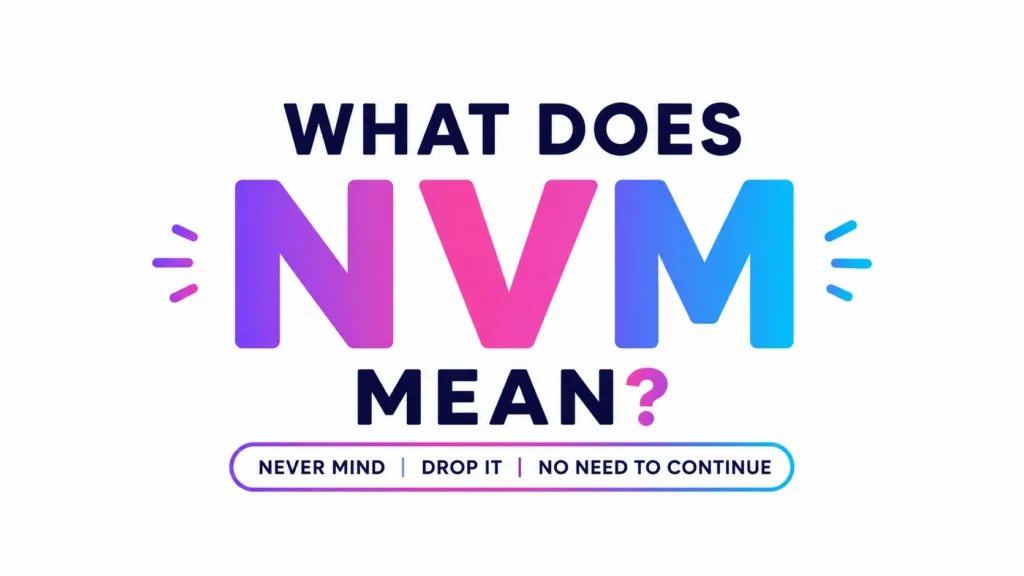
NVM stands for “Never Mind.”
People use it when they no longer need an answer, want to drop a topic, or decide something is no longer important.
Simple Definition
NVM means:
- Forget what I said.
- It doesn’t matter anymore.
- I figured it out myself.
- Let’s move on from this topic.
Examples
“Can you help me with this assignment? NVM, I solved it.”
“Where are my keys? NVM, found them.”
“NVM, it’s not important.”
The exact meaning depends on the situation and tone of the conversation.
Origin & Background
The phrase “never mind” has existed in English for centuries. Long before texting became common, people used it in everyday conversations to dismiss a concern or move past a topic.
As digital communication grew during the late 1990s and early 2000s, people started shortening common phrases to type faster. Just as “LOL” replaced “laughing out loud” and “BRB” replaced “be right back,” “never mind” became NVM.
Mobile phones played a major role in its popularity. Early texting often involved limited character counts and small keypads, making abbreviations convenient.
Social media accelerated its spread. Platforms such as Instagram, TikTok, Snapchat, and messaging apps helped slang move across countries and cultures at incredible speed.
Today, NVM is recognized globally and remains one of the most widely used text abbreviations online.
Real-Life Conversations
WhatsApp Conversation
Andrew:
Did you send the project file?
David:
Not yet. Why?
Andrew:
NVM, I found it in my downloads folder.
David:
Good thing you checked.
Instagram DM
Emma:
What was the name of that coffee shop you recommended?
Sarah:
Which one?
Emma:
NVM, I just found your old post about it.
Sarah:
Perfect!
TikTok Comments
Jake:
Where can I watch this series?
Mason:
I think it’s on a streaming platform.
Jake:
NVM, I searched it and found it.
Mason:
Enjoy it!
Text Message
Olivia:
Are you upset with me?
Noah:
Why would you think that?
Olivia:
NVM. I was probably overthinking.
Noah:
It’s okay. Let’s talk about it.
These examples show how NVM can range from practical and neutral to emotional and personal.
Emotional & Psychological Meaning
NVM often reveals more than the words themselves.
Sometimes it simply means a person solved a problem independently. In that case, there is little emotional weight behind it.
In other situations, NVM can signal disappointment. Someone may ask a question, feel ignored, then use NVM as a way of withdrawing from the conversation.
People also use it to protect themselves from embarrassment. If they ask something personal and feel uncertain about the response, they may quickly say NVM to avoid feeling vulnerable.
A situation many people recognize goes something like this:
You send a message asking a friend if they want to hang out. Minutes pass. Then an hour. Feeling unsure, you send “NVM” because you no longer want to wait for an answer.
The abbreviation becomes more than a shortcut. It becomes an emotional signal.
Usage in Different Contexts
Social Media
On social media, NVM usually means the user found the answer independently or changed their mind.
Example:
“NVM, figured it out.”
Friends & Relationships
Friends often use NVM casually. The tone is usually relaxed and informal.
Example:
“NVM, I’ll ask someone else.”
In relationships, however, the phrase may sometimes indicate hurt feelings or frustration.
Work and Professional Settings
NVM can appear in workplace chats, though it should be used carefully.
Example:
“NVM, I located the report.”
This usage feels efficient and professional.
Casual vs Serious Tone
Casual use:
“NVM lol.”
Serious use:
“NVM. Forget I asked.”
The second example carries noticeably more emotional weight.
When NOT to Use It
Avoid using NVM in situations where clarity is important.
Formal Communication
Business emails and official correspondence usually require complete sentences.
Sensitive Discussions
If someone is discussing an important emotional issue, replying with NVM may appear dismissive.
Conflict Resolution
During disagreements, NVM can sometimes shut down productive conversation.
Cross-Cultural Communication
Some people interpret NVM as rude or passive-aggressive. Consider your audience before using it.
Common Misunderstandings
Many misunderstandings happen because tone is difficult to read through text.
Assuming It Is Always Rude
Most uses of NVM are completely harmless.
Assuming It Means Anger
People often use it simply because they found an answer.
Ignoring Context
The same abbreviation can carry different meanings depending on the conversation.
Taking It Literally
Sometimes NVM means “forget it.”
Other times it means “I don’t want to discuss it anymore.”
Context determines the intended message.
Comparison Table
| Expression | Meaning | Tone |
|---|---|---|
| NVM | Never mind | Neutral to emotional |
| IDC | I don’t care | Indifferent |
| JK | Just kidding | Playful |
| BRB | Be right back | Temporary absence |
| Forget it | Drop the topic | Often stronger |
| Actually | Correction or change | Neutral |
| FYI | For your information | Informative |
| Keep going | Continue discussing | Opposite of NVM |
Key Insight
NVM is unique because it combines practicality and emotion. A simple abbreviation can either signal a solved problem or reveal someone’s feelings, depending on the context.
Variations & Types
1. NVM
Standard abbreviation for never mind.
2. Nvm
A more casual capitalization style.
3. nvm
Common lowercase version used in texting.
4. NVM lol
Softens the message with humor.
5. NVM then
Suggests a change of direction after receiving new information.
6. NVM I got it
Shows the problem has been solved.
7. NVM thanks
Polite way to end a request.
8. NVM forget it
A stronger version showing finality.
9. NVM it’s okay
Used to reduce pressure or reassure someone.
10. NVM figured it out
Indicates self-resolution.
How to Respond When Someone Uses It
Casual Replies
- “Got it.”
- “Okay.”
- “Sounds good.”
- “No worries.”
Funny Replies
- “Mystery solved.”
- “Case closed.”
- “The detective strikes again.”
Mature Replies
- “Glad you found the answer.”
- “Let me know if you still need help.”
- “Happy to assist anytime.”
Respectful Replies
- “Understood.”
- “Thank you for letting me know.”
- “Feel free to reach out if needed.”
Regional & Cultural Usage
Western Culture
NVM is widely accepted in texting and social media. Most people immediately understand it.
Asian Culture
Many English-speaking internet users recognize NVM, though local messaging habits may influence how frequently it appears.
Middle Eastern Culture
The abbreviation is common among younger users who regularly communicate in English online.
Global Internet Usage
Gaming communities, social platforms, forums, and messaging apps have helped make NVM a worldwide expression.
Gen Z vs Millennials
Gen Z often uses NVM alongside newer internet slang and emojis.
Millennials commonly use it as a straightforward texting abbreviation without additional slang.
Both generations understand it, though their surrounding communication styles may differ.
Is It Safe for Kids?
Yes.
NVM is generally considered safe and family-friendly. It contains no offensive language and is commonly used to mean “never mind.”
Parents should still pay attention to the context. A child repeatedly using NVM during emotional conversations may be expressing frustration or withdrawal rather than simply ending a topic.
FAQs
What does NVM stand for?
NVM stands for “Never Mind.”
Is NVM rude?
Not usually. Context and tone determine whether it sounds polite or dismissive.
Can NVM be used in professional communication?
Yes, though complete sentences are often better in formal settings.
Is NVM the same as “forget it”?
Not exactly. “Forget it” can sound stronger and more emotional.
Why do people use NVM?
It saves time and quickly signals that a topic no longer needs discussion.
Is NVM popular on social media?
Yes. It appears frequently on platforms such as Instagram, TikTok, Snapchat, and messaging apps.
Should I respond when someone says NVM?
A brief acknowledgment is usually enough, especially if the issue has already been resolved.
Conclusion
NVM may be one of the shortest abbreviations online, yet it carries surprising depth. At its simplest, it means “never mind.” In everyday conversations, though, it can reveal independence, impatience, relief, disappointment, or a desire to move forward.
The key is understanding the context. A friend who says NVM after finding an answer is communicating something very different from someone who says it during an emotional conversation.
Once you recognize those subtle differences, interpreting messages becomes much easier. Whether you encounter NVM in a text, social media comment, or direct message, you’ll be able to understand the intent behind it and respond with confidence.