Text messaging has transformed the way people communicate. Short abbreviations now carry entire messages in just a few letters. One of the most common examples is OTW. If you’ve received a text saying “OTW” and wondered exactly what it means, you’re not alone.
Many people search for this abbreviation after seeing it in a text message, social media conversation, group chat, or direct message. The meaning is usually simple, yet context can influence how it is understood.
Learning the meaning of OTW helps you respond naturally and avoid confusion. It also gives insight into how modern communication values speed, convenience, and efficiency.
Whether you’re chatting with friends, coordinating plans, or scrolling through social media, understanding OTW can make conversations much clearer.
What Does OTW Mean in Texting – Quick Meaning
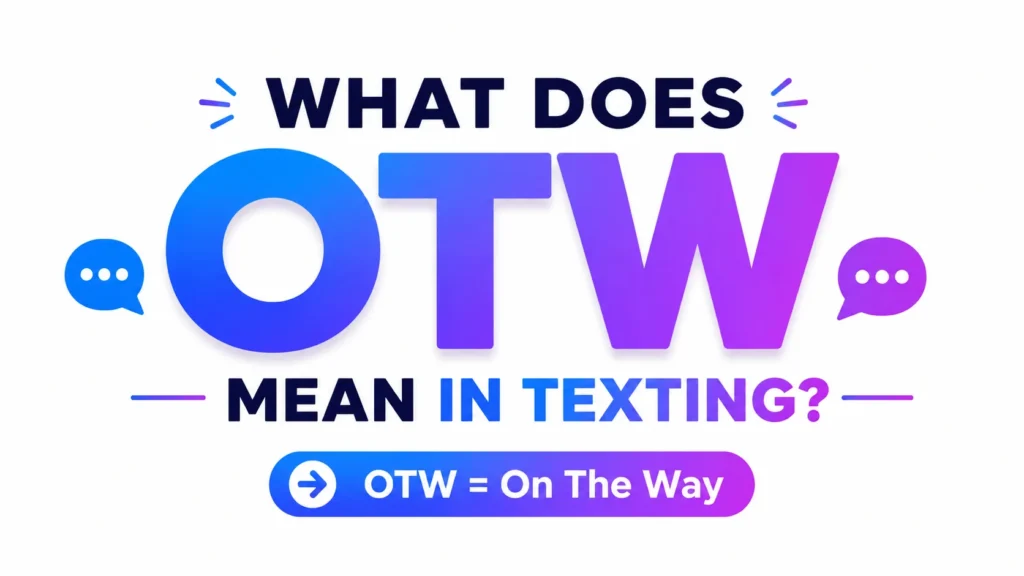
OTW stands for:
“On The Way”
It tells someone that a person, object, delivery, or event is currently moving toward a destination.
Common uses include:
- Letting someone know you’re traveling to meet them
- Confirming you’re leaving for a location
- Updating someone about progress
- Informing others that something is arriving soon
Examples:
“I’m OTW now.”
“Food is OTW.”
“Don’t worry, we’re OTW.”
The abbreviation is short, convenient, and widely understood across texting platforms.
Origin & Background
OTW emerged during the early years of digital messaging.
Mobile phones originally had limited keyboards, making long messages slower to type. Users began shortening common phrases to save time and effort.
“On The Way” naturally became OTW.
The abbreviation spread through:
- SMS texting
- Instant messaging services
- Online chat rooms
- Social networking platforms
As smartphones became common, OTW remained popular despite improved keyboards. People appreciated its simplicity.
Social media strengthened its visibility. Instagram captions, Snapchat messages, TikTok comments, and WhatsApp conversations frequently include OTW because it communicates movement and progress in just three letters.
The meaning has stayed remarkably consistent over the years.
Unlike some internet slang that changes rapidly, OTW still means essentially what it meant when it first appeared.
Real-Life Conversations
WhatsApp Conversation
Andrew:
Where are you?
David:
OTW. Traffic is a little slow.
Andrew:
No problem. I’ll grab us a table.
David:
Perfect. See you soon.
Instagram DM
Sophia:
Did you get my package?
Emma:
Not yet.
Sophia:
Tracking says it’s OTW.
Emma:
Great. I’ve been waiting for it.
TikTok Comments
Jake:
New video dropping tonight.
Mia:
Can’t wait.
Jake:
Editing is finished. Upload is OTW.
Mia:
Looking forward to it.
Text Message
Nathan:
The meeting starts in fifteen minutes.
Olivia:
I know. I’m OTW now.
Nathan:
Safe drive.
Olivia:
Thanks.
Emotional & Psychological Meaning
At first glance, OTW appears purely practical.
There is often a subtle emotional layer behind it.
When someone sends OTW, they are usually offering reassurance.
The message communicates:
- Commitment
- Reliability
- Progress
- Responsibility
- Respect for another person’s time
A simple OTW can reduce uncertainty.
Imagine waiting for a close friend at a restaurant. Minutes pass without hearing anything. Frustration begins to build.
Then a message arrives:
“OTW.”
The mood changes immediately.
The abbreviation provides clarity and reassurance. You now know the person is making an effort to arrive.
That emotional value explains why OTW remains popular despite being so simple.
Usage in Different Contexts
Social Media
OTW often appears in captions and posts.
Examples include:
- “New content OTW.”
- “Vacation photos OTW.”
- “Big announcement OTW.”
In these cases, it builds anticipation.
Friends and Relationships
Friends frequently use OTW when coordinating plans.
The abbreviation helps keep communication quick and casual.
Partners may also use it as a reassuring update when traveling to meet each other.
Work and Professional Settings
OTW occasionally appears in workplace messaging apps.
Examples include:
- “The report is OTW.”
- “The documents are OTW.”
- “I’m OTW to the office.”
Professional environments may still prefer complete sentences in formal communications.
Casual vs Serious Tone
OTW works well in casual conversations.
Professional situations often allow it in internal messaging.
Formal documents and business correspondence usually benefit from more complete wording.
When NOT to Use It
Although OTW is widely accepted, certain situations call for clearer language.
Formal Business Writing
Avoid OTW in:
- Contracts
- Formal reports
- Official announcements
- Academic papers
Full phrases create greater clarity.
High-Stakes Situations
Important updates sometimes require more detail.
A simple OTW may not provide enough information during urgent circumstances.
Cross-Cultural Communication
Not everyone understands English texting abbreviations.
International audiences may appreciate complete wording instead.
Sensitive Conversations
Messages involving emergencies, medical concerns, or significant events should prioritize clarity over shorthand.
Common Misunderstandings
Assuming Immediate Arrival
OTW does not necessarily mean someone is nearby.
A person could be five minutes away or an hour away.
Confusing Physical and Figurative Usage
OTW can refer to actual travel.
It can also describe something being prepared or coming soon.
For example:
“New music OTW.”
No physical movement is involved.
Assuming Exact Timing
The abbreviation signals progress rather than a precise arrival time.
Additional details may still be necessary.
Misreading Tone
Most uses are straightforward.
Occasionally, someone may say OTW before actually leaving, which can create frustration if expectations differ.
Comparison Table
| Expression | Meaning | Tone | Usage |
|---|---|---|---|
| OTW | On The Way | Reassuring | Arrival or progress |
| BRB | Be Right Back | Casual | Temporary absence |
| ETA | Estimated Time of Arrival | Informative | Arrival timing |
| ASAP | As Soon As Possible | Urgent | Fast action |
| IDC | I Don’t Care | Indifferent | Personal opinions |
| FYI | For Your Information | Informative | Sharing updates |
| WYA | Where You At? | Curious | Asking location |
Key Insight
OTW stands out because it combines action and reassurance. It tells someone that progress is happening while reducing uncertainty about what comes next.
Variations / Types
OTW
The standard abbreviation meaning “On The Way.”
Im OTW
Confirms personal travel toward a destination.
OTW Now
Indicates immediate movement.
Already OTW
Suggests the journey has already begun.
Package OTW
Refers to a shipment in transit.
Food OTW
Common in delivery conversations.
Results OTW
Used when updates are expected soon.
New Content OTW
Popular among creators and influencers.
Update OTW
Signals information will arrive shortly.
Big News OTW
Creates anticipation for an announcement.
How to Respond When Someone Uses It
Casual Replies
- Sounds good.
- See you soon.
- Great, thanks.
- Take your time.
Funny Replies
- I’ll start the countdown.
- The red carpet is ready.
- Your fans are waiting.
- Finally, the legend arrives.
Mature Replies
- Thank you for the update.
- Travel safely.
- I appreciate the notice.
- Looking forward to seeing you.
Respectful Replies
- Thanks for letting me know.
- Safe travels.
- I’ll be here when you arrive.
- Much appreciated.
Regional & Cultural Usage
Western Culture
OTW is extremely common in North America, Europe, and Australia.
Most active texters recognize it instantly.
Asian Culture
Many younger users understand OTW through exposure to global social media and entertainment.
English abbreviations often mix with local languages.
Middle Eastern Culture
OTW appears frequently among bilingual internet users.
Messaging apps have helped spread its usage across different communities.
Global Internet Usage
The abbreviation has become part of international online culture.
Many users understand it even when English is not their first language.
Generational Differences
Gen Z
Gen Z regularly uses OTW in texting, gaming chats, and social media conversations.
The abbreviation feels natural and efficient.
Millennials
Millennials also use OTW extensively.
Many helped popularize texting abbreviations during the rise of mobile messaging.
Is It Safe for Kids?
Yes.
OTW is generally safe for children.
The phrase simply means “On The Way” and does not carry harmful, offensive, or inappropriate content.
Parents should still encourage children to understand context and communicate responsibly online.
FAQs
What does OTW mean in texting?
OTW stands for “On The Way” and indicates that someone or something is moving toward a destination.
Is OTW positive or negative?
It is usually neutral or positive because it provides an update and reassurance.
Can OTW refer to objects?
Yes. Packages, deliveries, documents, and other items can be described as OTW.
Is OTW used on social media?
Absolutely. It appears frequently on Instagram, TikTok, Snapchat, WhatsApp, and other platforms.
Does OTW mean arriving soon?
Not necessarily. It means movement has started, though arrival time may vary.
Is OTW professional?
It can be acceptable in informal workplace chats, though formal communication often requires complete wording.
Can OTW be used figuratively?
Yes. People often use it to announce upcoming content, projects, or news.
Conclusion
Understanding what does OTW mean in texting makes modern conversations much easier to follow. The abbreviation stands for “On The Way” and serves as a quick update that someone or something is currently heading toward a destination.
Its popularity comes from its simplicity. Three letters can communicate progress, reassurance, reliability, and intention. Friends use it when meeting up, coworkers use it to provide updates, and social media creators use it to build anticipation.
Context remains important because OTW can describe physical travel or upcoming announcements. Once you recognize both uses, the abbreviation becomes easy to understand.
The next time someone texts OTW, you’ll know exactly what they mean and how to respond with confidence.