If you’ve ever received a message containing WBU and paused for a moment trying to understand it, you’re not alone. Texting abbreviations have become a major part of online communication, especially among younger users who value speed and simplicity.
Many Spanish speakers search for “que significa WBU en ingles” because the abbreviation appears frequently in social media comments, direct messages, gaming chats, and everyday text conversations. Without context, it can feel confusing.
The good news is that WBU is actually one of the easiest internet abbreviations to understand. Once you learn its meaning, you’ll start noticing it everywhere.
This guide explains what WBU means, where it came from, how native English speakers use it, and how you can respond naturally when someone sends it to you.
Que Significa WBU en Ingles – Quick Meaning
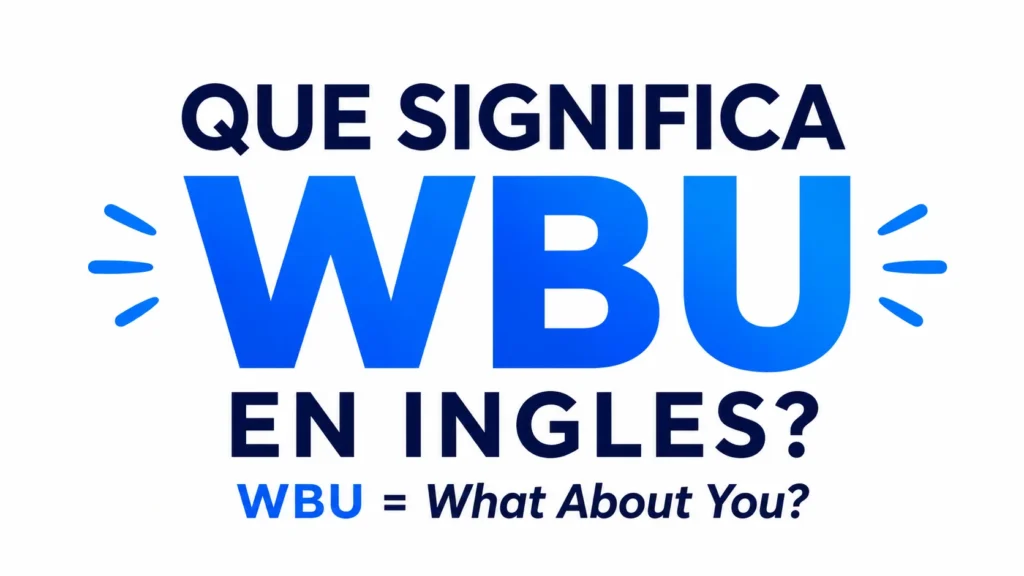
WBU stands for:
“What About You?”
In Spanish, this translates to:
“¿Y tú?” or “¿Qué hay de ti?”
People use it when they want to return a question and continue a conversation.
Quick Examples
“I’m doing great today. WBU?”
“I love watching movies on weekends. WBU?”
“I’m studying English this year. WBU?”
The abbreviation helps keep conversations flowing without typing a complete sentence.
Origin & Background
WBU emerged during the rise of text messaging in the late 1990s and early 2000s.
At that time, mobile phones often limited message length. Users looked for ways to shorten common phrases while still communicating clearly.
“What about you?” became one of the expressions frequently reduced into an acronym because it appeared in everyday conversations.
As online communication expanded, WBU spread across:
- SMS texting
- Online chat rooms
- Facebook Messenger
- Instagram DMs
- Snapchat
- TikTok comments
- Gaming communities
Its popularity grew because it encourages interaction. Rather than focusing solely on one person, it invites the other participant to share their thoughts or experiences.
Today, WBU remains one of the most widely recognized abbreviations in English-language texting.
Real-Life Conversations
WhatsApp Conversation
Andrew: I just finished my exams.
David: Nice! How do you feel?
Andrew: Relieved, honestly. WBU?
David: Still have two more next week.
Instagram DM
Sophia: I’m spending the weekend at the beach.
Emma: That sounds relaxing.
Sophia: It really is. WBU?
Emma: I’m visiting my grandparents.
TikTok Comments
Liam: This song has been stuck in my head all week.
Noah: Same here.
Liam: What’s your favorite part? WBU?
Noah: Definitely the chorus.
Text Message
Rachel: I’ve been trying to learn Spanish.
Mason: That’s awesome.
Rachel: It has been challenging but fun. WBU?
Mason: I’ve been studying French lately.
Emotional & Psychological Meaning
At first glance, WBU may appear to be a simple abbreviation.
Its deeper purpose is social connection.
When someone asks “What about you?” they shift attention toward the other person. That small gesture creates balance within a conversation.
WBU often communicates:
- Interest
- Curiosity
- Respect
- Inclusion
- Engagement
Digital communication can sometimes feel one-sided. WBU helps prevent that by inviting participation.
I remember chatting with a friend who always responded with detailed stories but rarely asked questions. The conversations felt uneven. Once they started ending messages with “WBU?”, the exchanges became much more natural and enjoyable.
Those three letters created a stronger sense of mutual interest.
Usage in Different Contexts
Social Media
WBU appears frequently on:
- Snapchat
- TikTok
- X
Users often ask followers about opinions, preferences, or daily activities.
Example:
“I love traveling during summer. WBU?”
Friends and Relationships
Among friends, WBU keeps conversations active.
It shows that both people matter equally in the discussion.
In relationships, it can express genuine interest in a partner’s experiences and feelings.
Work and Professional Settings
WBU is generally too informal for professional communication.
Instead, people usually write:
- What about you?
- How about you?
- And your thoughts?
These alternatives sound more polished.
Casual vs Serious Tone
WBU works best in casual environments.
During serious discussions, many people prefer complete sentences to avoid appearing overly informal.
When NOT to Use It
Although WBU is harmless in most situations, there are occasions where full wording is a better choice.
Formal Emails
Professional messages should avoid texting abbreviations.
Academic Writing
Teachers and professors generally expect standard English.
Job Applications
Using internet slang may appear unprofessional.
Sensitive Discussions
Emotional conversations often benefit from thoughtful, complete responses.
Conversations with Unfamiliar Audiences
Not everyone understands texting abbreviations.
Clarity matters more than speed.
Common Misunderstandings
Thinking WBU Has Multiple Meanings
Unlike many acronyms, WBU almost always means “What About You?”
Assuming It Is Rude
Some people see short abbreviations as lazy.
Most users simply view WBU as efficient communication.
Confusing It with Other Acronyms
Beginners sometimes mix WBU with:
- WYD
- WYA
- IDK
- HBU
Each serves a different purpose.
Missing the Conversational Intent
WBU is more than a question.
It invites the other person to participate.
Comparison Table
| Expression | Meaning | Usage | Tone |
|---|---|---|---|
| WBU | What About You? | Returning a question | Friendly |
| HBU | How About You? | Similar purpose | Casual |
| WYD | What Are You Doing? | Asking about activity | Informal |
| WYA | Where You At? | Asking location | Casual |
| IDK | I Don’t Know | Expressing uncertainty | Neutral |
| IMO | In My Opinion | Sharing views | Neutral |
| TBH | To Be Honest | Giving honest opinion | Personal |
| BRB | Be Right Back | Temporary absence | Informal |
Key Insight
WBU succeeds because it keeps conversations balanced. It encourages dialogue rather than turning communication into a one-person monologue.
Variations and Types
1. WBU
What About You?
The most common version.
2. HBU
How About You?
Very similar in meaning.
3. And You?
A complete phrase alternative.
4. What Bout U?
A casual spelling variation.
5. How About U?
Informal text version.
6. U?
Ultra-short texting style.
7. Your Turn
Encourages a response.
8. What Do You Think?
Requests opinions specifically.
9. Tell Me About You
A more detailed invitation.
10. Your Thoughts?
Often used in discussions and debates.
How to Respond When Someone Uses It
Casual Replies
- I’m doing well.
- Not much, just relaxing.
- Pretty good today.
- Same here.
Funny Replies
- Surviving one coffee at a time.
- Living the plot twist.
- Trying to look productive.
Mature Replies
- Things have been going well lately.
- I’ve been focused on work and family.
- I’m learning a lot these days.
Respectful Replies
- Thank you for asking.
- I appreciate your interest.
- I’m doing well, thanks.
Regional & Cultural Usage
Western Culture
WBU is extremely common among teenagers and young adults.
Texting culture strongly supports abbreviations.
Asian Culture
Many English learners encounter WBU through social media and entertainment.
The abbreviation is particularly popular among younger internet users.
Middle Eastern Culture
WBU appears frequently in English-language chats and international online communities.
Global Internet Usage
Social platforms have made WBU recognizable around the world.
Many users learn it before mastering conversational English.
Generational Differences
Gen Z
Uses WBU naturally and frequently.
The abbreviation feels effortless and modern.
Millennials
Generally understand WBU but may use complete phrases more often in certain situations.
Is It Safe for Kids?
Yes.
WBU is considered a safe and harmless abbreviation.
Its purpose is simply to ask another person about their thoughts, experiences, or activities.
Parents should still teach children that context matters online, but WBU itself is not offensive or inappropriate.
FAQs
What does WBU mean in English?
WBU means “What About You?”
What is the Spanish translation of WBU?
The closest translations are “¿Y tú?” and “¿Qué hay de ti?”
Is WBU formal English?
No. It is mainly used in casual conversations.
Is WBU popular on social media?
Yes. It appears frequently on messaging apps and social platforms.
Can adults use WBU?
Absolutely. Many adults use it in informal communication.
Is WBU the same as HBU?
Almost. Both ask the other person to share information about themselves.
Why do people use WBU?
It saves time and keeps conversations interactive.
Conclusion
Understanding que significa WBU en ingles is surprisingly simple once you know the abbreviation stands for “What About You?” In Spanish, it translates naturally as “¿Y tú?” or “¿Qué hay de ti?”
The expression plays an important role in digital communication because it invites participation and shows interest in the other person. Rather than ending a conversation, it keeps the exchange moving forward.
Whether you encounter WBU on WhatsApp, Instagram, TikTok, Snapchat, or in everyday text messages, you can now recognize its meaning instantly and respond with confidence. Small abbreviations often carry big social value, and WBU is one of the best examples of that principle.